



Research / Annual reports / Main research results of the Yukhnovskii Institute for Condensed Matter Physics of NAS of Ukraine in 2025
Main research results of the Yukhnovskii Institute for Condensed Matter Physics of NAS of Ukraine in 2025
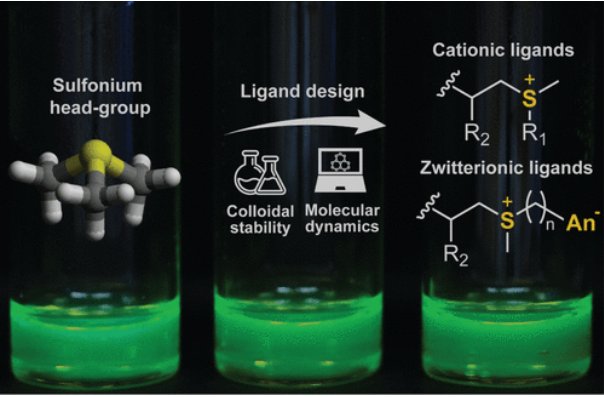
The ongoing quest for improved capping ligands for lead halide perovskite nanocrystals (LHP NCs) is fueled by the immense potential of these emitters as classical and quantum light sources. Herein, we introduce a structurally diverse library of long-chain trialkylsulfonium ligands that provide robust surface passivation of CsPbBr3 and MAPbBr3 NCs, achieving photoluminescence quantum yields approaching 90% for cationic and exceeding 90% for zwitterionic ligands. Classical force-field molecular dynamics simulations assess the trialkylsulfonium ligand headgroup as a close analogue of a frequently used quaternary ammonium headgroup in terms of its binding to the perovskite surface. When comparing trialkylsulfonium ligands that differ by the number and positions of long alkyl chains, the conformational flexibility of the ligand was found to play a dominant role in determining the ligand binding strength, surpassing the influence of headgroup geometry or substitution. Guided by this fundamental understanding, we rationally designed sulfonium sulfonate zwitterionic ligands that form robust colloids, also under extreme dilution. The resulting NCs exhibit a suppressed blinking rate (on-time fraction ~85%) and high single-photon purity (g2(0) = 0.12). Furthermore, applying “entropic” sulfonium ligands facilitates the stabilization of highly concentrated NC colloids (up to 1.1 g of inorganic mass per mL). These findings benchmark sulfonium-based ligands as practically applicable for diverse applications of LHP NCs, including quantum photonics and downconversion layers for displays (O. Kolomiiets, A. Stelmakh, A. Rajan, S. Sabisch, G. Rainò, A. Baumketner, M.V. Kovalenko, M.I. Bodnarchuk, ACS Nano, 19, No. 30, 27860–27872 (2025)).
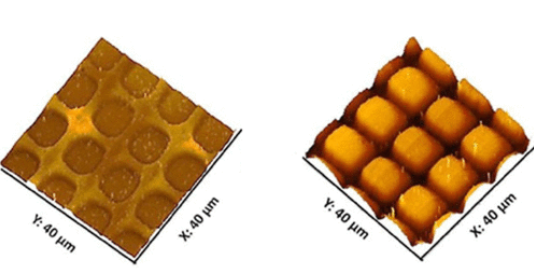
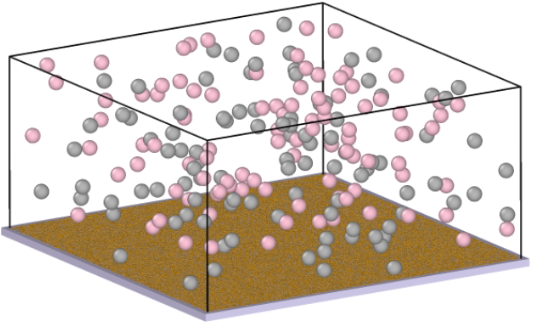
Microstructured surfaces composed of adherent domains and stimuli-responsive polymer domains (that undergo swelling–shrinking upon stimuli, e.g., temperature change around the low critical solution temperature, LCST) were proven to catch and release colloidal particulates (CP) effectively. Such structures have the advantage over just uniform stimuli-responsive surfaces because on the microstructured surface, sticky and pushing-off properties are decoupled so that the properties of each domain can be adjusted in a broad range. We consider the adsorption and desorption of particulates on the stimuli-responsive surface made of tethered poly(acrylic acid) (PAA) domains that contain the adherent functional motifs and thermoresponsive poly(N-isopropylacrylamide) (PNIPAM) domains, both arranged into regular micropatterns. At temperatures above the PNIPAM LCST, the PNIPAM domains collapse in water, allowing the adsorption of the particulates on the PAA regions. When cooled below the LCST, PNIPAM swells and pushes particles off the surface. We develop coarse-grained models for the CP on the microstructured surfaces and use computer simulations to analyze the optimal structure of such surfaces in terms of the PAA chain length, types of the micropatterns, the ratio between surface areas of the PAA and PNIPAM domains, and micropattern graininess in relation to particle dimensions. The study is relevant and motivated by the problems of harvesting and sorting prokaryotic and eukaryotic cells on microstructured surfaces (J. Ilnytskyi, D. Yaremchuk, S. Minko, Langmuir, 41, No. 20, 12731–12744 (2025)).
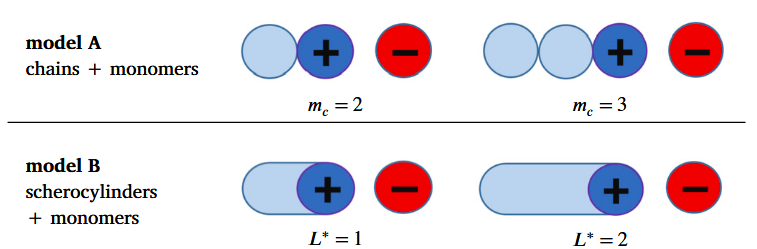
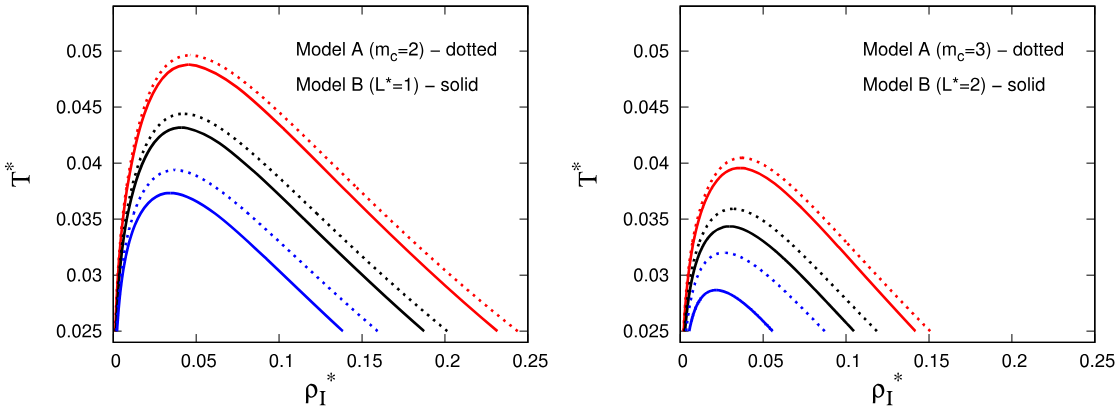
The vapour-liquid phase behaviour of room-temperature ionic liquids (RTILs) confined in disordered porous media is investigated using a theoretical approach that combines an extension of scaled particle theory, Wertheim’s thermodynamic perturbation theory and the associative mean-spherical approximation. Two models differing in the shape of the cation molecule are considered: one with cations represented as charged flexible chains, and the other with cations modelled as charged hard spherocylinders. The porous medium is modelled as a matrix of randomly distributed hard spheres. The associative interactions between oppositely charged ions result in a mixture of dimerized and free ions. The present study focuses on elucidating the influence of cation molecular shape, partial ion association and disordered confinement on the valour-liquid phase transition in the model RTILs considered. Within the proposed approach, it is found that both the critical temperature Tc and the critical density ρc in the model with spherocylindrical cations are lower than those in the model with chain-like cations, and that the phase coexistence region is narrower. The obtained results show qualitative agreement with available computer simulation data reported in the literature. This work represents the first theoretical attempt to describe an RTIL model with molecular ions of spherocylindrical shape, in particular under conditions of disordered porous confinement (T. Hvozd, T. Patsahan, O. Patsahan, Yu. Kalyuzhnyi, M. Holovko, Journal of Molecular Liquids, 426, 127240 (2025)).
Label-free cell-sorting methods and materials are developed in this work. The microstructured thermoresponsive surfaces made of poly (glycidyl methacrylate) (PGMA) and poly(N-isopropylacrylamide-co-glycidyl methacrylate) (PNIPAM-co-GMA) are prepared by phase separation on the submicron scale in thin films, then crosslinked and covalently grafted to the substrate. PGMA domains are used for cell adhesion, while the PNIPAM-co-GMA matrix pushes cells off the surface at a temperature below the lower critical solution temperature (LCST). The microstructure formation and swelling-shrinking caused by changes in temperature are studied experimentally and using dissipative particle dynamics computer simulations. Experiments with RAW 264.7 murine macrophage-like cells, NIH3T3/GFP murine fibroblasts, and HaCaT human skin keratinocytes (unlabeled and GFP positive strains) demonstrate successful cell sorting based on the weak and nonspecific interactions with the reconfigurable thermoresponsive microstructured surfaces. Efficient sorting with a separation factor above 50% is achieved if the push-off force is adjusted to the level between the adhesive forces of the separating cells. This experimental finding is supported by the Monte Carlo simulations of cell adsorption and detachment on the microstructured surfaces. The experiment and simulations show that efficient cell sorting is possible for weak to moderate cell adhesion to the surfaces. However, the method is not successful for very weak and very strong adhesion. We demonstrate that the cell adhesion to the microstructured surfaces can be adjusted by changes in conditions of the phase separation at the stage of the film formation and variation of the incubation time of the cells on the microstructured surfaces (R. Badenhorst, S.V. Makaev, M. Parker, R. Marunych, V. Reukov, A. Będzińska, O. Korchynskyi, O. Kalyuzhnyi, D. Yaremchuk, J. Ilnytskyi, T. Patsahan, S. Minko, ACS Applied Materials & Interfaces, 17, No. 35, 49193-49209 (2025)).
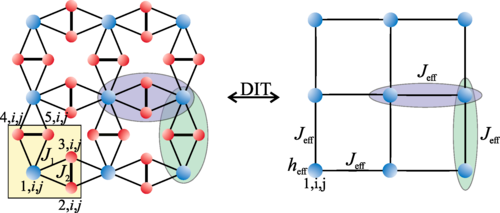
Non-Markov equations of hydrodynamics in fractional derivatives for non-equilibrium values of particle number densities, their momentum, and energy for viscoelastic fluids using the non-equilibrium statistical operator method in Gibbs statistics are obtained. For isothermal processes (β = 1/kBT = const), the non-Markov Navier–Stokes equation in fractional derivatives for viscoelastic fluids is obtained. Models of the frequency dependence of the memory function (viscosity) are considered, which lead to a generalized equation in fractional derivatives in space and time for the non-equilibrium value of the particle momentum density (or generalized Navier-Stokes) for the generalized Maxwell fluid model, the generalized Oldroyd B fluid model (P. Kostrobij, B. Markovych, I. Ryzha, O. Viznovych, M. Tokarchuk, Physics of Fluids, 37, No. 7, 073118 (2025)).
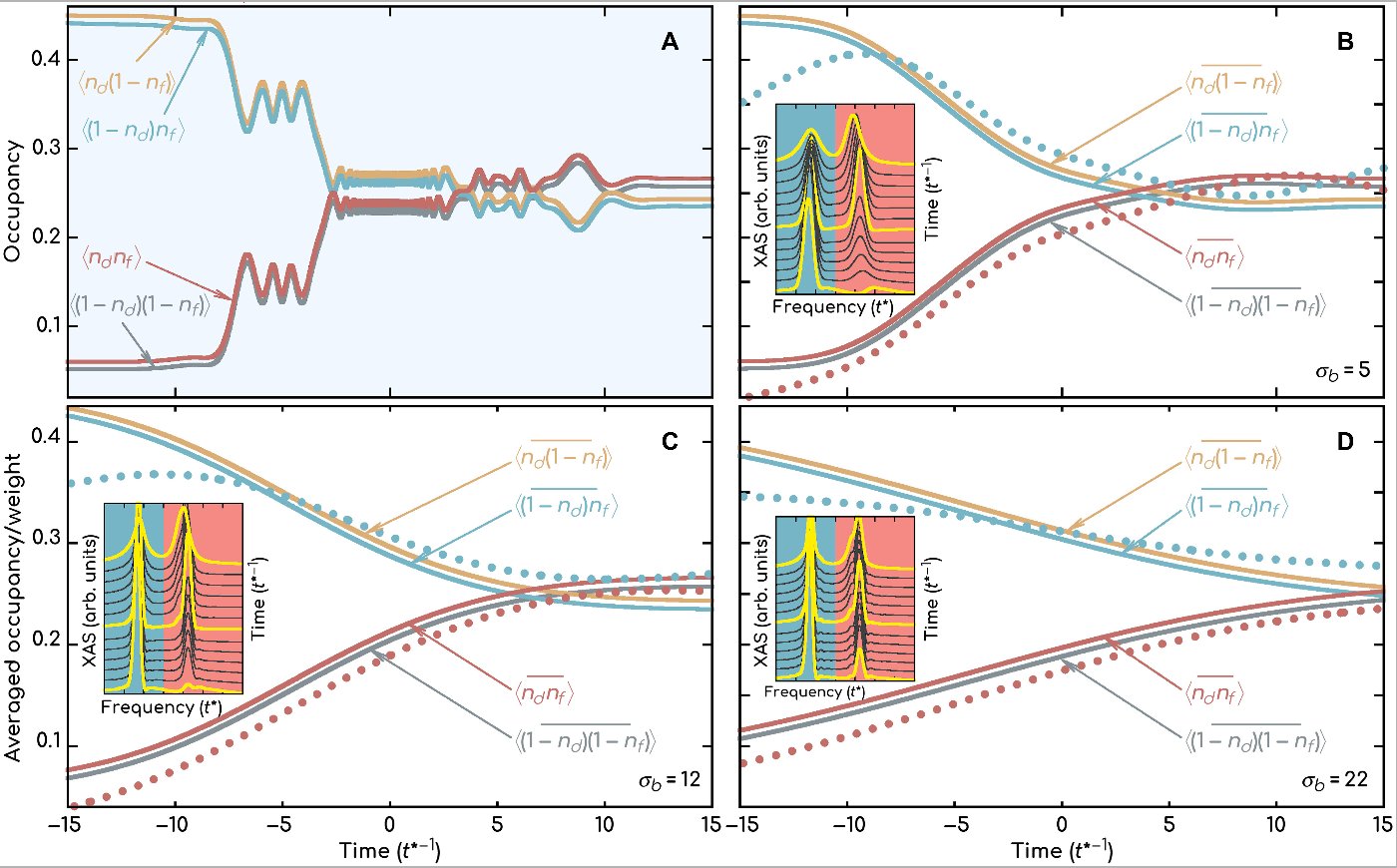
We show how time-resolved x-ray photoemission and absorption spectroscopies can be employed to measure both the effective energy content and ultrafast, correlated charge dynamics in the electronic subsystem considering simple model within the non-equilibrium dynamical mean field theory. This scheme takes advantage of a time-dependent correlation between the integrated spectral weight of core-level photoemission/absorption peaks and electronic correlation functions, enabling unprecedented insights into the ultrafast, time-averaged dynamics of electron correlations in strongly interacting many-body systems. Such an approach allows for the effective electronic temperature to be determined free of any fitting to a thermal distribution function, following appropriate calibration. As a proof of concept, this scenario was experimentally verified by tracking the ultrafast transfer of spectral weight in the x-ray absorption spectrum of a prototypical, strongly correlated material, CeO2, following impulsive photoexcitation (O. Matveev, A. Shvaika, S. Kwon, S.H. Park, A. Katoch, N. Sirica, J. Freericks, Ultrafast Science, 5, 0117 (2025)).
Pseudospin models are proposed for description of the phase transitions, dielectric characteristics, and polarization switching in two crystals of the phenyltetrazole family. One of them, APHTZ, is a canted ferroelectric, whereas the other, MPHTZ is a simple antiferroelectric. In APHTZ the electric field, applied perpendicularly to the axis of spontaneous polarization, flips the polarization in one of the two sublattices, effectively rotating the non-zero net polarization by 90◦ and switching the system between two different ferroelectric configurations. The temperature-electric field phase diagrams areconstructed. The diagram topology appears to be typical for the Ising-like antiferroelectric systems (A.P. Moina, Physical Review B, 112, No. 21, 214111 (2025)).
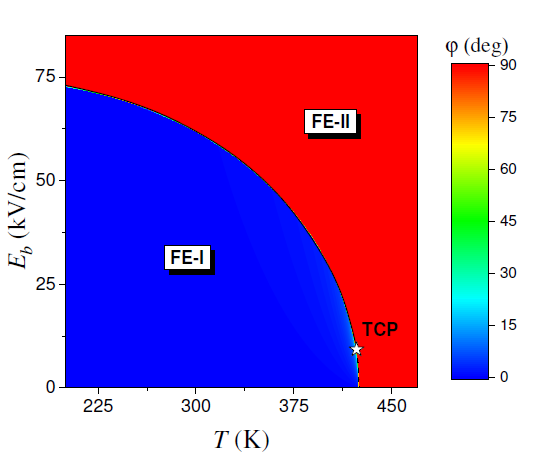
The T-Eb phase diagram and color contour plot of the angle between the net polarization vector and the a axis for the APHTZ crystals. Solid and dashed lines: first and second order phase transitions, respectively; TCP: the tricritical point.
Typically, the effect of structural disorder on the magnetic phase transition in a 3D Ising model is analyzed in the framework of the theory of dilution by a nonmagnetic component, where some lattice sites are occupied by Ising spins and others are nonmagnetic. We have recently proposed a new generalized Ising model, namely the Ising model with variable spin length. For a random mixture of two Ising magnets with two different spin lengths (1 and s) and concentration c, we have performed an extended Monte Carlo simulation. In this case, we analyzed the effect of structural disorder as such, without introducing a nonmagnetic component. Our results demonstrate the emergence of a universality class of the Ising model with 3D random dilution in a random mixture of two Ising magnets. Although the asymptotic critical values coincide with those known for the node-diluted 3D Ising model, the effective critical behavior is driven by the parameters s and c. The effect of their interaction is the subject of detailed analysis (J.J. Ruiz-Lorenzo, M. Dudka, M. Krasnytska, Yu. Holovatch, Physical Review E, 111, 024127 (2025)).
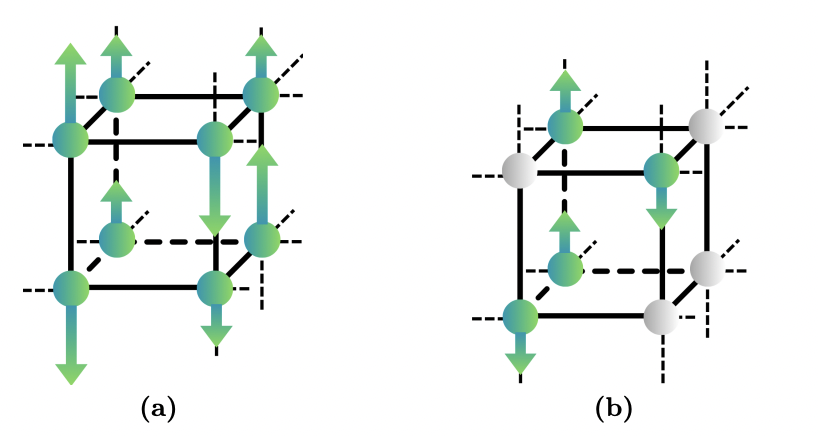
(a) A special case of the Ising model with variable spin length: a mixture of two Ising magnets with two different spin lengths. (b) A diluted Ising model, where some nodes (gray) are occupied by nonmagnetic compounds or are empty.
We considered a model of collective decision making that takes into account individual biases of each agent. Agents in this model are simulated as Ising spins with an additional internal degree of freedom describing the bias towards one of two possible states. This model is a cellular automaton-type model, where the probability of changing the state of each agent depends on the states of its neighbors and the individual bias itself. The focus of our study was the susceptibility of such a model, since it has been shown that real biological systems often operate near the critical point where susceptibility is high allowing for accurate decision-making. We showed that there are three mechanisms that allow the system to adapt to changes in the external noise level so that susceptibility remains high: increasing the connectivity of the system; the emergence of long-range connections that were not there before; changing the parameter describing the tendency of agents to order according to the local majority (Yu. Sevinchan, P. Sarkanych, A. Tenenbaum, Yu. Holovatch, P. Romanczuk, Physical Review Research, 7, 013286 (2025)).
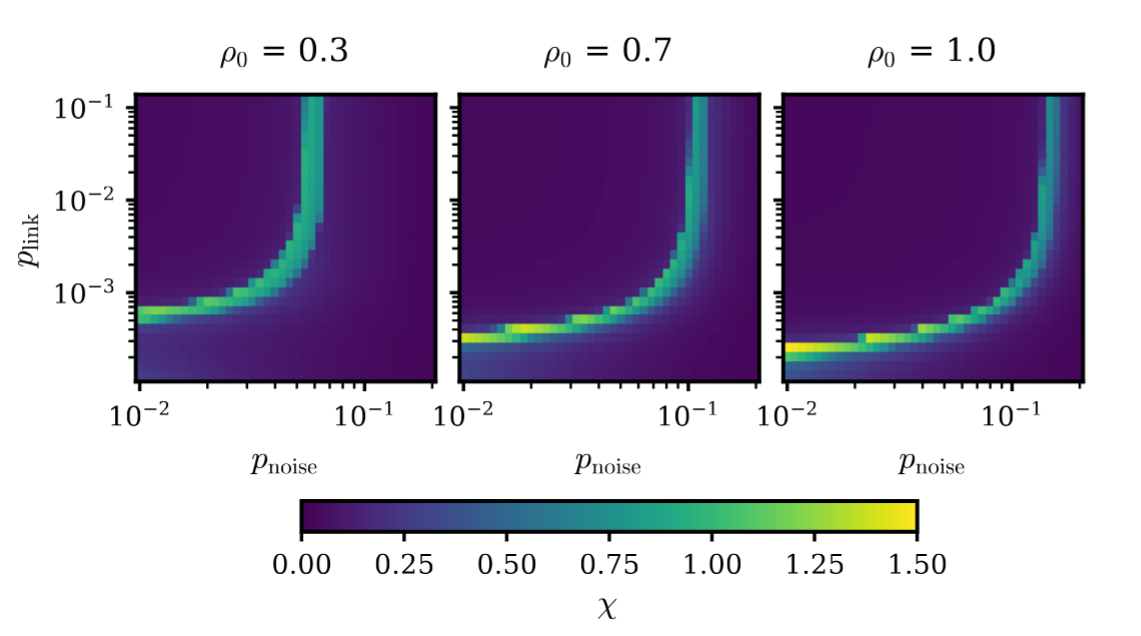
Magnetic susceptibility as a function of node connectivity probability and external noise intensity for different densities of unbiased nodes.