



Structure / Departments / Department for Quantum Statistics
Department for Quantum Statistics
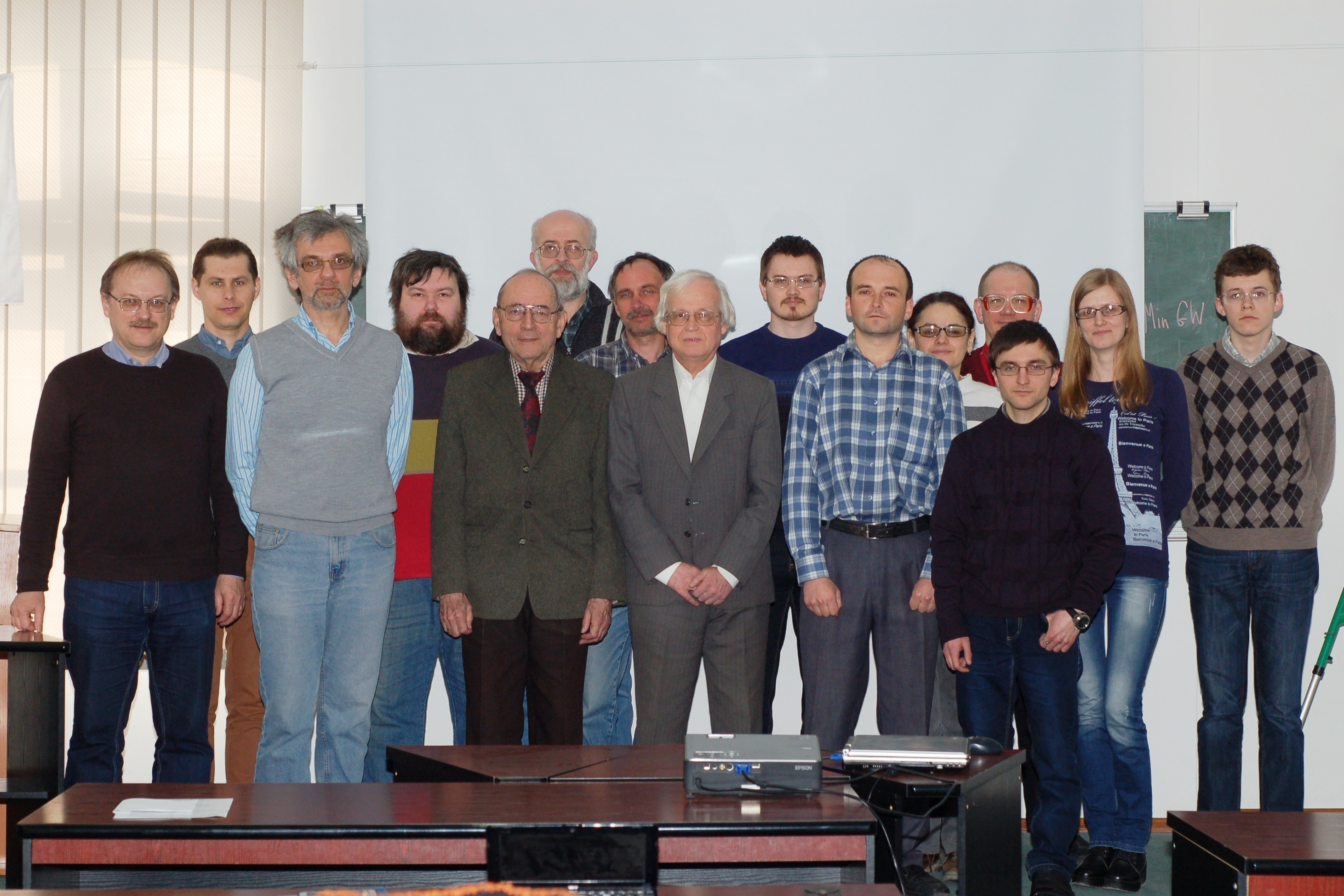
The Department was founded in March 1980. Professor Ivan Oleksandrovych Vakarchuk was the first head of the Department (April 1, 1980 — September 17, 1984). Since March 21, 1986 and till April 30, 2016 it was headed by Corresponding Member of the National Academy of Sciences of Ukraine, Professor Ihor Vasylovych Stasyuk. In April 2016 the Department of Quantum Statistics and the Department for Model Spin Systems Theory were unified and Doctor of Physical and Mathematical Sciences Oleg Volodymyrovych Derzhko became the head of the Department. Since the beginning of 2026, the department has been headed by Taras Verkholyak, D.Sc. Among the former members of the Department there are O.L.Ivankiv, Yu.V.Kozitski, I.M.Kopych, S.S.Kotsur, H.V.Ponedilok, Yu.K.Rudavskyi, O.Ya.Saban,V.M.Tkachuk and others. Meanwhile, there are 17 researchers at the Department. Namely, 6 Doctors of Sciences: O.V.Derzhko, A.M.Shvaika, Ya.Y.Shchur, O.V.Velychko, A.S.Vdovych, T.M.Verkholyak, 10 PhD: T.Ye.Krokhmalskii, R.Ya.Stetsiv, A.P.Moina, B.M.Lisnyi, O.R.Baran, O.P.Matveyev, G.O.Skorobagatko, O.M.Krupnitska, V.O.Krasnov, Yu.I.Dublenych, T.I.Hutak. There are 2 PhD students at the Department (M.R.Parymuda, P.V.Sapriianchuk).
Research area of the Department covers a wide range of topics of current condensed matter physics such as the theory of strongly correlated systems (Hubbard, Falicov-Kimball, Heisenberg models), the theory of ultracold gases and intercalated layered crystal structures (Bose-Fermi-Hubbard and Bose-Hubbard models), the studies of classical and quantum spin models, in particular in low dimensions and with frustration, the investigations of ferroelectric ordering and other properties of ferroelectrics including the ones of nanosize. To these ends, various methods of equilibrium and nonequilibrium statistical mechanics are used. For instance, the Green functions approach or exactly solvable models as well as numerical methods such as the electronic density functional method, exact diagonalizations, classical and quantum Monte Carlo etc. All studies are aimed on obtaining the experimentally observable quantities, in particular, magnetization and polarization, specific heat, conductivity and thermoelectric coefficients, susceptibilities, optical spectra and inelastic (Raman) light and x-ray scattering spectra, as well as on constructing phase diagrams for a wide range of models and compounds. The researchers of the Department combine original analytical and numerical methods in their studies on the theory of strong electron correlations, magnetic and ferroelectric systems. There is a long-standing scientific collaboration with research groups from Germany, USA, Slovakia, Poland, Brazil.